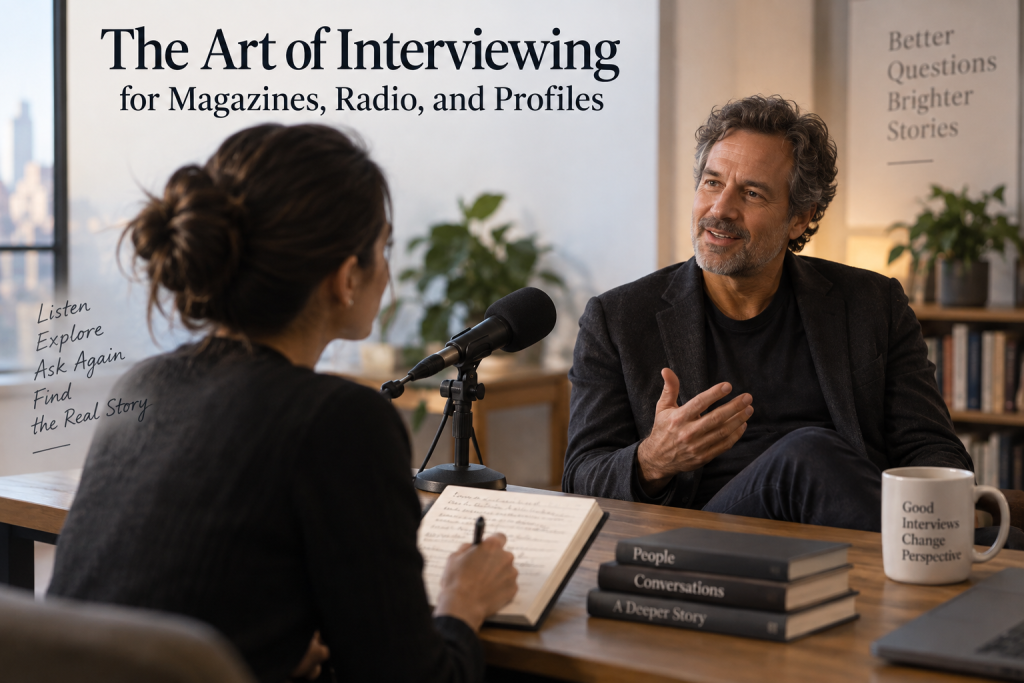
The Art of Interviewing for Magazines, Radio, and Profiles
By Mboneni Stan Mulaudzi
The best interviews rarely feel like interviews; instead, they feel like focused conversations in which the subject stops performing and begins to think out loud. It is in these moments that you get more than just facts; you get memory, tension, personality, contradiction, and the occasional sentence that carries an entire story. Reaching that point takes work, as a strong interviewer must research thoroughly without becoming trapped by prepared questions. They have to know when to press, when to pause, and when to abandon the plan because the subject has opened a more interesting door.
The fundamentals apply across magazine journalism, radio, podcasts, and personality profiles. The craft changes with the medium, though. A magazine writer needs scenes and precise details. A radio host needs a voice that holds the listener’s attention. A profile writer needs enough evidence to portray a person honestly, not merely as that person wishes to be portrayed.
Here’s how to do it well.
What Makes a Great Interview?
A truly great interview yields insights that a simple internet search never could. It might reveal a private memory, explain the reasoning behind a decision, expose a contradiction, or capture a uniquely telling phrase. Ultimately, it leaves the audience feeling as though they have met the subject, rather than just learned about them. That requires three skills working in harmony:
Preparation helps you ask informed questions.
Listening helps you recognize the unexpected.
Judgment tells you which moments matter and when to explore them.
Research earns you access to the deeper conversation. Listening determines what you do once you get there.
Research Until You Can Stop Showing It
Interview preparation should begin with the obvious material: biographies, previous interviews, articles, speeches, public records, books, social media, and the subject’s recent work. If you’re profiling someone, speak to people around them whenever possible. The goal isn’t to display your research during the interview. It’s to avoid wasting time on questions already answered elsewhere and to notice when a claim conflicts with the record.
Build a simple research file with several sections:
- A timeline of important events
- Previous statements and recurring stories
- Unanswered questions or inconsistencies
- Names, places, and dates requiring confirmation
- Topics the subject discusses often
- Topics they tend to avoid
- Details that could produce scenes or memories
Past interviews are particularly valuable, as they show which anecdotes have been refined through constant retelling. A story repeated verbatim across multiple appearances may remain true, but it is unlikely to offer anything new. Rather than asking the subject to recount it, approach from a different angle. If they often mention leaving home at seventeen, don’t ask, “Why did you leave?” Instead, try, “What did you pack?” or “What did the room look like on your final morning?” Specific questions can disrupt the surface of a rehearsed narrative and uncover the person beneath it.
Decide What the Interview Is Really About
A subject is not a story; noting that “the interview is with a famous chef” merely identifies the guest rather than the point. Instead, the story might be about ambition, burnout, family inheritance, the economics of restaurants, or what success costs when a private craft becomes a public identity. To find this focus, write one sentence before the interview describing what you think the piece may be about. Treat this as a working theory rather than a verdict—for example: “This is a story about an athlete trying to decide who she is when competition no longer defines her.” That sentence gives the interview direction, suggesting questions about identity, routine, fear, status, and life after sport. If the conversation reveals a better story, however, feel free to follow it; good preparation should provide a path, not build a fence.
Write Prompts, Not a Script
A long list of tightly written questions can make an interviewer feel safe. It can also make them stop listening.
Organize your notes by topic instead:
- Childhood and early influences
- A decisive turning point
- Conflict or failure
- Current work
- Relationships
- Habits and private routines
- The central tension of the story
- What comes next
Under each topic, prepare a few questions and possible follow-ups. Mark the essential ones, but don’t feel obliged to ask everything. The next question should often come from the previous answer—not from the next line on your page.
Begin With Something Concrete
“Tell me about yourself” is broad enough to invite a biography already delivered many times. Abstract opening questions can also make a subject retreat into generalities.
Start with something easy to picture:
“Where are you speaking from today?”
“What were you doing just before we started?”
“When did you first realize the project was in trouble?”
“Take me back to the morning you received the call.”
Concrete questions help people retrieve memories rather than summarize them. They also provide physical material for the eventual article or broadcast: rooms, weather, movement, objects, clothing, gestures, and sound. Unless there’s a compelling reason to begin confrontationally, allow a little time for the conversation to find its rhythm. Rapport makes difficult questions more productive later.
Ask Open Questions, Then Narrow the Lens
Open-ended questions invite stories:
“What happened next?”
“How did you make that decision?”
“What do people misunderstand about that period?”
“What changed after the article appeared?”
“What did you expect would happen?”
Once the subject begins answering, narrow the lens. Ask for chronology, sensory detail, and exact language.
“Who else was in the room?”
“What could you hear?”
“What did she say?”
“What did you say back?”
“How long did you wait?”
“What happened immediately afterward?”
The movement between wide and narrow questions gives an interview shape. Wide questions reveal meaning. Narrow questions make that meaning tangible.
Ask for Scenes, Not Summaries
Profile writing depends on scenes. Radio benefits from them too because listeners can build the moment in their minds.
Subjects naturally summarize:
“It was a difficult year.”
A summary identifies a theme but doesn’t prove it. Ask the subject to choose a moment that contains the theme:
“What happened during that year that captures how difficult it was?”
“Where were you?”
“Who was with you?”
“What do you remember doing?”
“What did you not tell anyone at the time?”
A useful scene usually contains a setting, action, other people, dialogue, and some kind of pressure. It doesn’t need to be dramatic. Watching a subject cook breakfast for a parent can reveal more than a formal account of their values.
Listen for the Door in the Answer
Interviewees often signal where the real story is hidden. They might shift tenses, become unusually precise, laugh at odd moments, avoid using a name, or drop a loaded phrase and quickly move on. Suppose someone says: “That was the last time I trusted him, but anyway, the company recovered by June.” The novice interviewer asks about June. The perceptive interviewer asks, “Why was that the last time you trusted him?”
Listen for:
- Sudden emotion
- Changes in pace or tone
- Vague language around specific events
- Names introduced without explanation
- Contradictions
- Unexpectedly vivid details
- Phrases such as “to be honest” or “I’ve never said this before”
- A quick attempt to leave a subject behind
These moments aren’t automatic proof of deception or trauma. They are signals that a follow-up may be worthwhile.
Simple prompts often work best:
“What do you mean by that?”
“Can you give me an example?”
“Why did that matter?”
“Tell me more.”
“What aren’t I understanding?”
According to Indeed, follow-up questions demonstrate attention and help an interviewer explore an anecdote or idea more deeply. In journalism, they’re often where the interview actually begins.
Use Silence
Silence feels longer to the interviewer than to anyone else. After asking a tough question, pause. When the subject finishes their answer, wait one beat more. People often use that space to revise a guarded response, recall a detail, or share something they had initially withheld. Don’t use silence as a performative pressure tactic; just resist the urge to fill every gap. A quiet “And then?” can produce more than a three-part question.
Don’t Put the Answer in the Question
Leading questions encourage agreement rather than reflection. For example, asking “You must have been devastated” tells the subject how to feel. Asking “How did you react?” is better. It leaves room for the truth, such as relief, anger, or amusement.
Avoid inflated questions meant to showcase your intelligence. If a question contains a miniature essay, the subject may only respond to one part or simply agree with your premise. Ask one clear question at a time. If you need to provide context, keep it brief.
How Magazine Interviews Are Different
Print gives you room to compress, reorder, and build meaning across a longer piece. It also places a heavy burden on reporting. A magazine interviewer needs material that can survive after the subject’s voice is removed from the room:
- Strong quotations
- Physical description
- Chronology
- Scenes
- Tension
- Context
- Corroboration
- Contradiction
- Small, revealing details
Pay attention before and after the formal interview. Notice how the subject treats staff, what they keep on the desk, whether they answer directly, which topics alter their mood, and what happens when they think the interview is over.
Observation is not mind reading. “She crossed her arms when asked about the lawsuit” is an observation. “She crossed her arms because she was lying” is speculation.
If you plan to describe someone’s appearance, behavior, home, or workplace, take precise notes. Memory tends to replace details with impressions.
Gather the Material You’ll Need Later
Before ending a magazine interview, check for gaps. Do you have the correct spelling for every name? Can you reconstruct the central event chronologically? Do you understand the subject’s true motivation, or only their public explanation? Is there enough physical detail to write a scene? Which claims require documents or independent confirmation? Remember, a beautiful quote cannot repair missing reporting.
How Radio and Podcast Interviews Are Different
In audio, the voice is part of the story. Tone, hesitation, laughter, rhythm, accent, and silence all carry meaning.
Radio questions need to be shorter because listeners can’t reread them. If an audience gets lost halfway through a complicated question, the answer may not rescue the segment.
Ask questions that create clear mental pictures:
“What could you see from the window?”
“What did the engine sound like?”
“Describe the room for someone who has never been there.”
“What did you do with your hands while you waited?”
Audio also requires stronger time management. A fascinating ten-minute detour may force you to abandon the question that gives the segment its ending. Keep an eye on the clock without allowing the conversation to sound hurried.
Protect the Sound
For remote interviews, ask the guest to use headphones, silence notifications, and choose a quiet room with soft furnishings. Before beginning, test both the connection and the recording. You should also record a local backup whenever possible, as online calls can fail and unstable connections may damage an otherwise excellent interview. If the production process calls for it, capture room tone, a short stretch of silence from the recording space and always confirm names, titles, and pronunciations on tape, since you should never assume an uncommon name is pronounced the way it looks.
Remember the Listener
A radio interview involves three people: the interviewer, the guest, and the listener.
Briefly establish the context if a new listener might be confused. Use names instead of pronouns like “he” or “she.” Avoid visual references that lack explanation. For example, instead of saying, “You’re pointing over there,” say, “You’re pointing to a photograph above the piano. Who is in it?” Remember that the audience cannot see the room. Your questions must help them visualize it.
How to Interview Someone for a Profile
A profile is not a transcript with an introduction attached. It’s a reported portrait. The subject’s account matters, but it is only one account. Interview colleagues, friends, relatives, critics, former partners, rivals, or anyone else with relevant firsthand knowledge. Read the documentary record. Visit meaningful places where possible.
Ask each secondary interviewee for scenes as well as opinions. “She’s generous” is an assertion. “She quietly paid three employees’ rent when the restaurant closed” is a reportable example that can be checked.
Search for friction between:
- Public identity and private behavior
- Ambition and consequence
- What the subject says and what others remember
- The origin story and the documented timeline
- A person’s values and their choices
- Reputation and daily routine
Contradiction is not automatically hypocrisy. People are inconsistent. A good profile doesn’t flatten those inconsistencies into a verdict; it examines them.
Ask the Same Event From Several Angles
For a pivotal event, interview everyone you can reach and ask each person to reconstruct it separately. Where were they? Who spoke first? What happened before and after? What did they believe at the time? What records exist? When accounts differ, don’t force them into false agreement. Attribute each version clearly and state what can be independently established.
Asking Difficult Questions
Hard questions become easier when they are specific, fair, and supported by reporting. Don’t disguise the subject. If the interview concerns an allegation, financial failure, broken relationship, or public controversy, ask about it directly. Give the person enough detail to understand what they are being asked to address. A fair question might sound like this:
“Two former employees told me that staff repeatedly raised concerns about unpaid overtime during 2024. They said you dismissed those concerns in a March meeting. What is your response?”
Then listen.
If the answer shifts to another subject, return to the question:
“I understand that the company was under pressure. I’m asking whether employees raised concerns about unpaid overtime and how you responded.”
Persistence does not require hostility. Stay calm, avoid arguing, and keep the focus on verifiable claims. Don’t wait until the final minute to raise every difficult issue. That gives the subject little time to respond and makes the exchange feel like an ambush. It may occasionally be necessary to sequence questions carefully, but fairness still requires a meaningful chance to answer.
Ethics, Consent, and Ground Rules
Before the interview, clarify your ground rules. Terms like “on the record,” “off the record,” and “on background” vary by newsroom and jurisdiction; never assume a shared definition. If a subject tries to go “off the record” after speaking, you aren’t automatically bound by it. However, your response should consider prior agreements, editorial policy, safety, and fairness. When in doubt, consult an editor before making commitments. Exercise extra caution with children, vulnerable individuals, or trauma survivors who may not grasp how publication works. Clearly explain the format, where the content will appear, and their lack of editorial control. Never promise favorable coverage or offer quote approval, unless explicitly permitted. Remember that verifying facts is distinct from allowing a subject to shape the tone or narrative. Finally, only record with proper consent and in compliance with local laws; legal permission does not always equate to ethical transparency.
Verify What You Hear
An interview is reported evidence, not automatic fact.
People misremember dates, combine separate events, exaggerate, protect themselves, repeat family myths, and tell sincere stories that turn out to be wrong.
Check factual claims against documents and independent accounts wherever possible. Pay particular attention to:
- Dates and ages
- Job titles
- Awards and credentials
- Financial figures
- Medical or scientific claims
- Legal allegations
- Quotations attributed to other people
- Claims that appear too neat
- Stories central to the subject’s public identity
A quotation can accurately represent what someone said and still convey false information. Accurate transcription and factual verification are separate responsibilities.
Take Better Notes and Protect the Recording
Recordings preserve language, while notes preserve judgment. Even when recording, you should write down timestamps, strong phrases, changes in mood, environmental details, unanswered questions, and claims that need verification. While the subject is still present, make sure to note spelling and pronunciation. Back up your recordings as soon as possible, using clear file names and retaining the original files. If the material is sensitive, be sure to follow your organization’s security and retention policies. Although transcription tools can save time, they often make mistakes, especially with names, technical terms, overlapping voices, and poor audio, so you must check every quotation against the recording before publication or broadcast.
Know When the Interview Is Ending—Then Ask One More Thing
Near the end, review your essential questions. Confirm practical details. Ask whether the subject wants to correct or clarify anything.
Then try one of these:
“What haven’t I asked that I should have?”
“What do people usually get wrong about you?”
“Is there something you expected me to ask?”
“Who else should I speak to?”
“What happened next?”
These aren’t magic questions, but they often loosen the conversation. The formal pressure has dropped, and the subject may introduce what mattered most to them all along. Keep recording until the exchange has clearly ended, assuming the agreed terms and consent remain in effect. Some of the most revealing moments arrive after the obvious final question.
Common Interviewing Mistakes
Asking Questions That Are Really Speeches
Long questions exhaust the audience and give the subject several escape routes. Cut the preamble and ask the central thing.
Following the List Instead of the Person
Prepared questions matter. So does recognizing when an unexpected answer is more valuable than your plan.
Interrupting Too Quickly
An interruption can break a memory just as it becomes specific. Step in when the answer is evasive or time is short, not merely because the subject paused.
Treating Emotion as Proof
Tears don’t verify a claim. Calmness doesn’t disprove one. Report the facts and avoid using demeanor as a shortcut to certainty.
Chasing a Predetermined Narrative
A working theory helps direct research. It becomes dangerous when every answer is forced to support it. Be willing to discover that your original premise was wrong.
Trying to Sound Clever
The interview exists to reveal the subject, not display the interviewer. A plain question that produces a vivid answer is better than an elegant question that produces confusion.
Ending Without the Basics
Many interviews fail for boring reasons: an unconfirmed surname, a missing date, an unclear sequence, or no usable explanation of what happened. Save time for housekeeping.
A Practical Interview Workflow
Before the Interview
Research the subject, identify the central tension, create a timeline, prepare topic areas, and verify the recording setup. Decide which questions are essential and which can be sacrificed if time runs short.
At the Beginning
Confirm the ground rules and intended use. Ask for name pronunciation and current title. Begin with a concrete question that allows the subject to settle into the exchange.
During the Conversation
Listen for unexpected details, contradictions, and emotional turns. Ask for scenes, dialogue, chronology, and examples. Keep questions short. Use silence. Mark claims that require verification.
Near the End
Return to anything unanswered. Ask difficult questions that remain. Confirm names, dates, numbers, and technical details. Invite the subject to add something you missed and recommend other people to contact.
Afterward
Back up the recording, expand your notes, verify quotations, create a fact-checking list, and identify reporting gaps. Follow up while the conversation is still fresh.
Interview Questions That Often Produce Strong Answers
Use these as prompts, not as a fixed script:
“What is the earliest moment you remember clearly?”
“Take me through that day from the beginning.”
“What did you believe then that you no longer believe?”
“When did you realize things had changed?”
“What did the room look like?”
“What happened that nobody outside the room saw?”
“Who disagrees with your version of this story?”
“What did the decision cost you?”
“What do you wish you had done differently?”
“What part of the public story is incomplete?”
“When you say it was difficult, what did that look like on an ordinary day?”
“Who else should I talk to if I want to understand this properly?”
The best question in an interview may still be the shortest:
“Why?”
Great Interviewing Is an Act of Attention
A great interview isn’t about being charming, aggressive, or quick-witted; it is the discipline of paying close attention. You prepare enough to know what matters, listen carefully enough to catch the unexpected, and ask for details without scripting the response. You challenge claims fairly, verify what can be fact-checked, and leave room for nuance.
Magazine writers seek evidence that translates into scenes. Radio interviewers look for voices, moments, and language that resonate with the ear. Profile writers must synthesize a subject’s story with observation, records, and the perspectives of others.
Across every format, the goal is the same: to help someone move past their rehearsed narrative toward something more specific, honest, and alive. That is the art of interviewing.