
The Price of Chasing Water: A South African Borehole Story
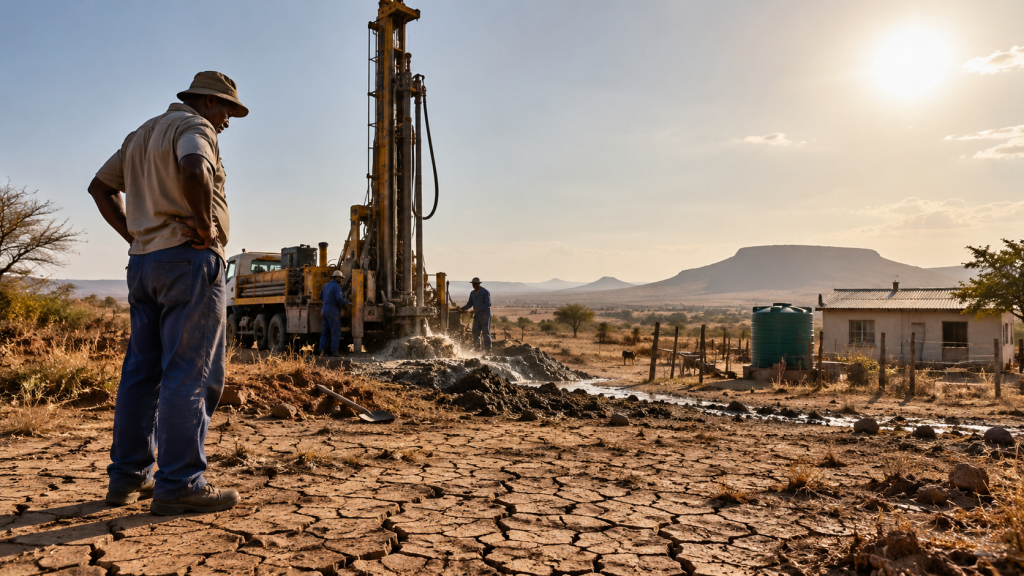
By the time I watched a second borehole descend to 155 metres, the R24,000 price that had first drawn me into the project felt less like a quotation than the opening sentence of a much longer story. I had responded to an advertisement for borehole drilling believing, reasonably enough, that the figure represented the cost of finding water. It did not. The first payment covered only the beginning. The drill went down, the work stopped, and I was told that continuing would cost more. That was the moment the arithmetic changed. I was no longer deciding whether to drill a borehole; I was deciding whether to abandon money already spent or risk more money on the possibility that water lay just a few metres farther down. The machine had created its own logic: once a hole exists, hope becomes expensive. I paid again. The drill went deeper. Still there was no meaningful water. I paid because I wanted to believe that geology might reward persistence, that the next metre might succeed where the previous hundred had failed. Eventually I tried another location. That hole reached 155 metres and produced only a small amount of water — enough to prove that something was there, but not enough to deliver the security I had imagined. The experience was financially bruising, but what unsettled me more was how quickly a basic human need had become a wager. Water is life; I knew that before the drilling began. What I did not know was how much one can spend simply trying to locate it.
The hidden cost of a borehole is not merely the invoice that arrives after the rig leaves. It is the sequence of decisions made under pressure while the rig is still there. When a contractor says the agreed depth has been reached without success, the homeowner stands in a peculiar psychological place. Stopping feels like wasting everything already spent. Continuing feels like buying another ticket in a lottery whose odds nobody can state with confidence. In my case, each new payment carried two things at once: hope and suspicion. I hoped water was close; I also began to wonder whether the process itself made it too easy for customers to keep spending without ever gaining certainty. The advertisement had made the project appear simple. The ground made it complicated. The experience taught me to ask questions I should have asked before the first drill bit touched soil: What exactly is included in the advertised price? At what depth does the quoted amount end? What is the cost per additional metre? Who decides when drilling should stop? Has the site been investigated scientifically? What happens if the hole is dry? What does casing cost? What about test pumping, a pump, electrical work, storage tanks, laboratory testing and treatment if the water quality is poor? None of those questions can eliminate geological risk, but they can expose financial risk before it becomes emotional. I had entered the process thinking I was buying a water solution. I discovered that, at least initially, I was buying an attempt. That distinction is one I wish I had understood at the beginning rather than at the bottom of a borehole.
My experience is personal, but the pressure that makes a borehole attractive is national. South Africa has achieved broad access to piped water, yet access and reliability are no longer the same thing. Statistics South Africa reported in its 2025 General Household Survey that 87.4 percent of households had access to piped water in a dwelling, yard or communal tap. But it also reported that the share of households experiencing water interruptions lasting more than two days at a time, or at least 15 days in total over the previous year, had risen to 37.6 percent in 2025 from 24.3 percent in 2012. That is the gap in which the private borehole has become so seductive. A tap on the wall is not water security if nothing comes out of it. In Gauteng, provincial authorities said in February 2026 that parts of Johannesburg, Ekurhuleni, Tshwane and Mogale City were experiencing intermittent supply problems linked to ageing infrastructure, leaks, high demand, power interruptions and maintenance backlogs. Nationally, the Department of Water and Sanitation has acknowledged widespread failures in municipal water and sanitation delivery and has argued that South Africa must broaden its water-resource mix because much of the sustainably usable surface-water resource is already being harnessed. In other words, the turn toward groundwater is not irrational panic. It is a response to a real deterioration in confidence. When municipal supply becomes intermittent, a borehole begins to look less like a luxury and more like insurance. The difficulty is that insurance normally transfers risk. A borehole often asks the household to absorb it.
The first scientific lesson is humbling: there is no vast underground lake waiting obediently beneath every property. South Africa’s National Groundwater Strategy says groundwater has become a source of domestic water and general livelihood support to more than 60 percent of communities in thousands of villages and small towns, but it also emphasises that much of the country’s groundwater occurs in hard-rock aquifers where yields can be limited. The Water Research Commission’s groundwater guide explains why one neighbour can drill successfully while another, not far away, can come up nearly empty. In many hard-rock settings, water is stored and transmitted through weathered zones, faults and fractures. A borehole that intersects a productive fracture can yield strongly; one that misses it can become an expensive cylinder of disappointment. In Karoo formations, which cover about half of the country’s surface, the rocks commonly have low borehole yields and low permeability, while fractured zones associated with dolerite intrusions can be far more productive. Dolomitic aquifers, by contrast, can have significant storage capacity and extremely high yields in favourable locations. That geological variety destroys the comforting idea of a universal success rate. The question is never simply, “Is there groundwater under South Africa?” There is. The real questions are whether there is accessible groundwater under this particular site, at this particular depth, in this particular geological formation, in sufficient quantity, of suitable quality, and at a rate that can be sustained. By the time I understood that distinction, I had already paid for the education with drilling metres.
That is why the most responsible borehole project starts before the drill arrives. The Department of Water and Sanitation maintains minimum standards and guidelines covering borehole siting, drilling, equipping and testing, and its groundwater material stresses the importance of testing a borehole to determine an appropriate pumping rate. The National Groundwater Strategy also contains a sobering estimate of the cost of poor information. Using assumptions current at the time, it calculated that poor borehole placement could cost South Africa roughly R500 million a year, with another roughly R500 million potentially lost through over-equipping boreholes after their yields were overestimated. Those figures come from a 2010 strategy and should not be mistaken for a current 2026 national loss estimate; their value is in showing the scale of waste that poor siting and poor yield estimation can create. A proper investigation does not guarantee success. That needs to be said plainly, because uncertainty does not disappear merely because a specialist arrives with instruments. But geological interpretation, geophysical investigation, careful siting, drilling records, test pumping and laboratory analysis replace blind optimism with evidence. They improve the quality of the decision. Looking back, I now understand that the cheapest quotation can become the most expensive route if it excludes the work needed to reduce uncertainty. A drilling price is not the same as the cost of a functioning water supply. The functioning system is the real product, and it may include investigation, drilling, casing, yield testing, pumping equipment, power, storage, treatment, maintenance and monitoring long after the rig has gone.
Then there is the question I was initially too focused on finding water to ask with sufficient force: if I find it, can I safely use it? Groundwater is hidden, not sealed. The Department of Water and Sanitation warns that groundwater can be polluted by poorly constructed pit toilets, livestock activities and mining, among other sources. Mining pollution is particularly instructive because it shows how distant the cause of contamination can be from the person who eventually pays for it. Acid mine drainage in the Witwatersrand has required major public intervention because acidic, mineral-laden mine water can threaten shallow aquifers and surface-water resources. South Africa’s broader wastewater problems add another layer of concern. In 2026, the Department reported that 47 percent of the municipal wastewater systems assessed in its latest Green Drop cycle were in a critical state, up from 39 percent in the 2022 assessment. A household borehole is therefore not automatically a purification device simply because it bypasses a municipal pipe. Water that looks clear can contain dissolved salts, metals, nitrates, microbes or other contaminants that cannot be judged by taste or appearance alone. That means laboratory testing is not a decorative extra to be considered after the budget has been exhausted. It is part of knowing whether the project has succeeded. A hole that produces water unsuitable for its intended use is not fully successful; it has merely reached liquid. My original fear was that I might spend money and find no water. The more I learned, the more I understood a second fear: spending money, finding water and discovering that the water creates another problem.
Quantity is just as deceptive as quality. A borehole can flow today and disappoint tomorrow. The Department describes controlled pumping tests as a way to determine how a borehole performs and the optimum rate at which it should be pumped. That matters because the presence of water is not the same as a sustainable yield. Groundwater levels respond to abstraction, recharge, drought, rainfall patterns and pumping from connected areas. The National Water Act treats the nation’s water resources as a public trust to be protected and managed sustainably and equitably, a principle that becomes easier to understand once one stops imagining a borehole as a private straw inserted into a private underground tank. Aquifers and fractured systems can extend beyond property boundaries. My pump, my neighbour’s pump and a community borehole some distance away may, depending on the geology, be drawing on connected groundwater. That is why monitoring matters after construction. A responsible owner needs to know whether water levels are declining, whether pumping is exceeding recovery, whether quality is changing and whether the system remains appropriate for the purpose for which it was installed. The Department’s National Groundwater Strategy makes sustainability central to future development precisely because South Africa increasingly needs groundwater as part of its national water-security mix. The irony is obvious: the more people turn to groundwater because surface systems are under pressure, the more carefully groundwater itself must be managed. Scarcity can drive us toward the underground resource, but unmanaged desperation can reproduce underground the very insecurity we are trying to escape above ground.
The borehole also reveals a social divide that is easy to miss when the conversation stays at the level of pumps and geology. I was able to spend money searching for water, even though the outcome hurt me financially. Many South Africans do not have the option to lose money on a dry hole because they do not have the money to drill one in the first place. The CSIR has documented the dependence of rural communities on springs and other groundwater sources where municipal systems struggle to serve dispersed settlements and where infrastructure backlogs and weak municipal revenue bases make conventional supply difficult. In those places, groundwater is not lifestyle infrastructure; it is daily survival. Government policy now reflects that reality. In July 2026, Cabinet said the first phase of the National Water Access Acceleration Programme included 67 decentralised water-supply schemes using boreholes and package plants in Gauteng, KwaZulu-Natal and the Eastern Cape, expected to benefit about 125,986 people, with more than R200 million allocated to the first phase. That is an important reminder that the answer cannot be “do not drill.” South Africa needs groundwater. Households need it, farms need it, villages need it and public authorities increasingly need it. The harder question is who gets access to good information, competent drilling, laboratory testing, maintenance and long-term monitoring. A household with sufficient means can respond to municipal failure by purchasing redundancy: tanks, pumps, filters, backup power and a borehole. A poor household may respond to the same failure with buckets, queues and distance. When private resilience becomes the main answer to public unreliability, water insecurity does not disappear; it becomes stratified.
The legal landscape is another reason the word “private” can mislead. Under Schedule 1 of the National Water Act, a person may take water for reasonable domestic use in a household, for small non-commercial gardening and for certain livestock watering, subject to the Act. Larger or different uses can fall under general authorisations or require a water-use licence, depending on the activity, volume, location and applicable conditions. The Department’s authorisation guidance distinguishes these categories and requires registration where a general authorisation says it is necessary. In December 2025, the Department also published proposed regulations for the protection and management of groundwater that would significantly expand the capture of borehole, geosite, drilling, yield-test and pump-setting information in the National Groundwater Archive. As of the Department’s groundwater-regulation page, those measures are described as proposed regulations, an important distinction. But the policy direction is unmistakable: South Africa wants a better record of what is being drilled, where, how much it can yield and how it is being used. That may sound bureaucratic to the homeowner who simply wants water to come out of a tap, but the data have practical value. Every undocumented borehole leaves a blank space in the national picture. Every recorded depth, geological log, yield test and quality result can make future decisions more intelligent. Better information can also make it harder for opportunists to sell certainty where only probability exists. One of the most expensive things I bought during my search was not drilling. It was ignorance — the information I did not have when the first quotation looked so attractively complete.
I still wish my story had ended differently. I would have preferred the clean ending: the rig drills, water rises, the tank fills, and the household gains independence. Instead, I came away with a small amount of water and a large education. I learned that self-sufficiency has a price, that infrastructure we take for granted can hide enormous complexity, and that a basic necessity becomes psychologically different once you have had to search for it underground. I no longer hear the phrase “water is life” as a slogan. I hear cost, geology, law, public infrastructure, inequality, chemistry, rainfall, pumps, fractured rock and the quiet anxiety of watching a drill disappear into the earth while nobody can tell you whether the next metre will change everything. I also learned to be suspicious of simplicity in advertising. A borehole should not be sold as though depth alone creates certainty. The responsible question is not “How much does drilling cost?” but “What will it take to establish a safe, sufficient and sustainable water supply here, and what happens if we fail?” South Africa cannot afford to abandon groundwater; the country’s own strategy makes clear that it will become increasingly important, and government is already using it to expand access in underserved communities. But neither can we afford to romanticise it as free water beneath our feet. The water may be there, but finding it costs money. Proving its yield costs money. Testing it costs money. Pumping it costs money. Protecting it costs money. Managing it costs money. Sometimes, after all of that, the ground gives only a trickle. My borehole taught me that the most precious resources are often the ones whose true price remains invisible until we are forced to go looking for them. Water is not free. Neither is security. And sometimes the deepest hole is the one drilled into our assumptions.