
When the Mouth Becomes a Trap: Learning the Wisdom of Silence
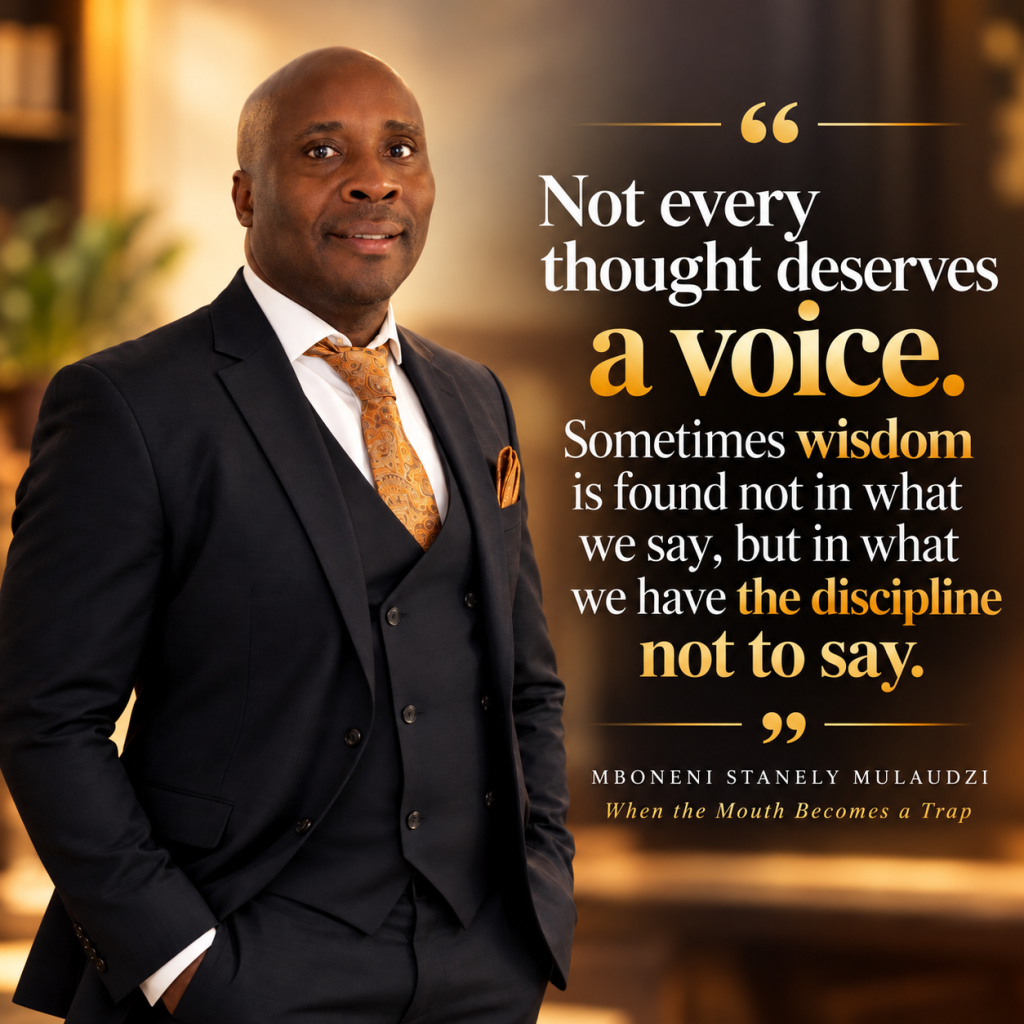
By Mboneni Stan Mulaudzi
There are lessons that life teaches politely, and there are others that arrive after the damage has already been done. One of the lessons I have had to learn repeatedly is that possessing the ability to speak does not necessarily mean that every moment requires my contribution. I love words, perhaps more than the average person does. I enjoy discovering them, shaping them, stretching them, listening to the way they sound and watching what happens when the right word occupies the right place in a sentence. Words have been part of my professional life, my writing, my broadcasting, my teaching and, in many ways, my identity. Yet the more I have worked with words, the more I have discovered their dangerous side. A beautifully constructed sentence can still be unnecessary, an intelligent observation can still be badly timed, and something that is factually correct can still cause damage simply because the moment never asked for it.
I have had moments when I realised this only after the words had already left my mouth. There is a peculiar helplessness that follows such a moment because words, unlike thoughts, cannot be recalled once another person has received them. You can explain what you meant, rearrange the sentence, add context and insist that your intention was different from the interpretation, but sometimes every additional explanation merely digs the hole deeper. I have learned that we often make the mistake of believing that words must repair what words have damaged, and so we continue speaking when the wisest contribution available to us is silence. We explain the explanation, clarify the clarification and eventually find ourselves defending something that might have disappeared quietly had we possessed the discipline to stop speaking.
This experience became part of the thinking behind my book, When the Mouth Becomes a Trap, because I became increasingly fascinated by the strange contradiction of human communication. The mouth was given to us as an instrument of connection, yet it can so easily become an instrument of destruction. Relationships have ended because of sentences that lasted less than ten seconds. Careers have been damaged by careless remarks made in meetings. Friendships have been weakened because somebody disclosed information that was never theirs to disclose. Families have carried wounds for decades because someone spoke while angry and later discovered that an apology could not completely erase what had been heard. We are sometimes taught to fear weapons while forgetting that the tongue requires no licence, no ammunition and almost no preparation before it can injure another human being.
As I have grown older, I have started paying more attention to the small space between thought and speech. That space may last only a second, but I have come to regard it as one of the most important territories in human communication because it is there that wisdom has an opportunity to intervene. Before something becomes a sentence, it is still negotiable. I can interrogate it, revise it, question my motive for saying it or decide that it deserves to remain where it originated. Once it leaves my mouth, however, ownership becomes complicated because although the words remain mine, their emotional consequences now belong to someone else. That person may carry them far longer than I remember having spoken them.
This lesson has followed me into professional environments, especially meetings and learning spaces, where speaking is often mistaken for contribution. I have watched people compete for conversational territory as though the number of sentences spoken determines the value of their presence. Sometimes the first person to speak confidently defines the entire discussion before everyone else has even finished understanding the problem. Once a senior person announces an opinion, people who might have disagreed suddenly begin adjusting their thinking around that opinion, not necessarily because they have been convinced but because hierarchy has entered the room. Over time I have learned that leadership sometimes requires the confidence to speak first, but there are equally important moments when leadership requires the discipline to speak last. When I withhold my view for a while, I create room for someone else to say what might never have been said after hearing mine.
Training environments have taught me something similar. A facilitator asks a question and, when nobody responds immediately, discomfort enters the room. Silence begins to feel like failure, and the temptation is to answer the question on behalf of the learners, rephrase it repeatedly or rescue them from the awkwardness. Yet I have discovered that people do not all think at the same speed, and speed itself is not evidence of intelligence. Some people need a few seconds to assemble their thoughts before they can make them visible. When we deny them those seconds, we sometimes reward the quickest speaker rather than the deepest thinker. The silence that follows a question is therefore not necessarily emptiness; sometimes it is a workshop in which an answer is still being constructed.
The same principle has changed the way I think about listening. For many years, like many people, I probably regarded listening as what happens while another person is speaking and I am waiting for my opportunity to respond. Experience has taught me that genuine listening requires more surrender than that because I must temporarily abandon the assumption that my story is the most relevant story in the room. Someone tells me about a difficulty, and my mind immediately searches through my own archive for a similar experience. Before the person has finished, I am ready with, “That happened to me as well,” followed by my own account. What begins as an attempt to show empathy can quietly become a takeover of the conversation. I have learned that sometimes the most respectful thing I can give another person is not my comparable experience but my undivided attention.
Grief has made this lesson particularly visible to me. When someone has lost a person they love, we often become frightened by our inability to repair the situation, and because silence makes us uncomfortable, we reach for familiar sentences. We say that everything happens for a reason, that time heals, that the deceased is in a better place or that the grieving person must remain strong. These words are usually spoken with good intentions, yet grief does not always need interpretation. Sometimes it needs companionship. There are moments when sitting beside someone, allowing them to speak when they want to speak and allowing them to remain quiet when language has deserted them, communicates more compassion than the most carefully assembled paragraph. I have discovered that presence can speak without requiring the mouth to participate.
My relationship with silence has also changed because of the world in which we now live. We exist in an age where almost every thought can be published immediately. Something irritates us and within seconds we can post about it, comment on it, forward it, record ourselves discussing it or send a message to someone while anger is still composing the vocabulary. Technology has shortened the distance between emotion and expression, which means that we increasingly have to create our own pause deliberately. The unsent message has become one of the quiet victories of modern life. Nobody applauds you for the insult you typed and deleted, nobody congratulates you for the argument you decided not to join, and there is no notification celebrating the fact that you waited until morning before responding to an email that angered you, yet some of our wisest communication may consist precisely of words nobody ever receives.
I have occasionally written a message while irritated and then deliberately left it alone. When I return to it later, I sometimes meet a version of myself whom I am glad I did not introduce to the recipient. The facts may still be correct, but the temperature has changed. Words such as “always” and “never” begin disappearing. Accusations become questions, assumptions become requests for clarification and sentences written to punish become sentences written to solve. Nothing outside me has necessarily changed during that period; what changed was the person doing the writing. This has taught me that sometimes we do not need better vocabulary as much as we need better timing.
I have also learned that apologies become traps when we cannot tolerate the silence after saying that we were wrong. We apologise and immediately begin explaining ourselves because we want the other person to understand our intentions. We say, “I am sorry, but…” and everything after the word “but” slowly begins dismantling everything that came before it. We describe the pressure we were under, the circumstances that provoked us and the reasons why our behaviour should be interpreted more generously. Without noticing it, the apology becomes another argument in which the injured person is expected to understand the person who caused the injury. Experience has taught me that sometimes an apology must be allowed to stand without bodyguards. I was wrong. I hurt you. I am sorry. Then comes the difficult part: allowing the other person to decide what happens next.
However, I do not believe that silence is always wisdom, and this distinction matters deeply to me. Silence can protect dignity, but it can also protect wrongdoing. It can prevent unnecessary conflict, but it can also allow injustice to continue unchallenged. There are circumstances in which refusing to speak is not maturity but fear, and there are people who have been silenced for so long that telling them to “speak less” would merely reinforce the very condition from which they need liberation. I therefore do not romanticise quietness. The lesson I have learned is not that the quietest person is necessarily the wisest person, because some truths require a voice and some moments become dangerous precisely because everybody who knows better decides to say nothing.
This is why I have become less interested in the quantity of speech and more interested in its purpose. Before I speak, particularly in difficult situations, I increasingly try to ask myself what I want the sentence to accomplish. Am I trying to clarify something, or am I merely trying to win? Am I contributing information, or demonstrating that I possess information? Does this story belong to me to tell? Am I about to disclose something because it is necessary, or because being the person who knows it makes me feel important? Will what I am about to say improve the conversation, or am I simply uncomfortable with the silence? These questions do not always arrive in time, and I am certainly not presenting myself as someone who has mastered them, but I have learned enough to respect them.
Perhaps this is one of the ironies of being someone who loves language as much as I do. The deeper my appreciation of words becomes, the less casually I want to use them. A person who respects a powerful instrument does not handle it recklessly. Words can educate, reconcile, inspire, encourage and illuminate, but those same words can humiliate, expose, provoke, confuse and destroy. The power of speech is therefore inseparable from the responsibility of restraint. Knowing many words is not wisdom if I have not also learned which ones should remain unspoken.
That is one of the personal truths sitting beneath When the Mouth Becomes a Trap. The trap is not simply speaking too much, because there are times when speaking at length is necessary, beautiful and even courageous. The trap begins when the mouth moves faster than judgement, when emotion chooses our vocabulary, when ego disguises itself as honesty and when we mistake everything we know for something everyone needs to hear. It begins when we forget that truth itself requires timing, context, compassion and ownership.
I am still learning this lesson because I suspect it is one of those lessons from which nobody ever truly graduates. There will always be another conversation in which irritation arrives before wisdom, another meeting in which speaking feels more attractive than listening, another message that seems urgent at night and unnecessary in the morning, and another sentence standing at the door between thought and expression waiting for permission to leave. What I now understand is that I do not have to grant that permission merely because the sentence exists.
Sometimes wisdom speaks beautifully. Sometimes wisdom asks a question and listens carefully to the answer. Sometimes wisdom confronts what everybody else is afraid to name, and sometimes it sits quietly beside another human being without attempting to repair the unrepairable. The challenge is not simply to become a person who speaks less, but to become a person who understands what speech is for. When I can recognise the difference between a sentence that needs a voice and one that needs a grave, the mouth stops being merely an instrument of expression and becomes an instrument governed by judgement. That, perhaps, is where mature communication begins: not with mastering the art of saying everything well, but with acquiring the wisdom to know that everything does not need to be said.