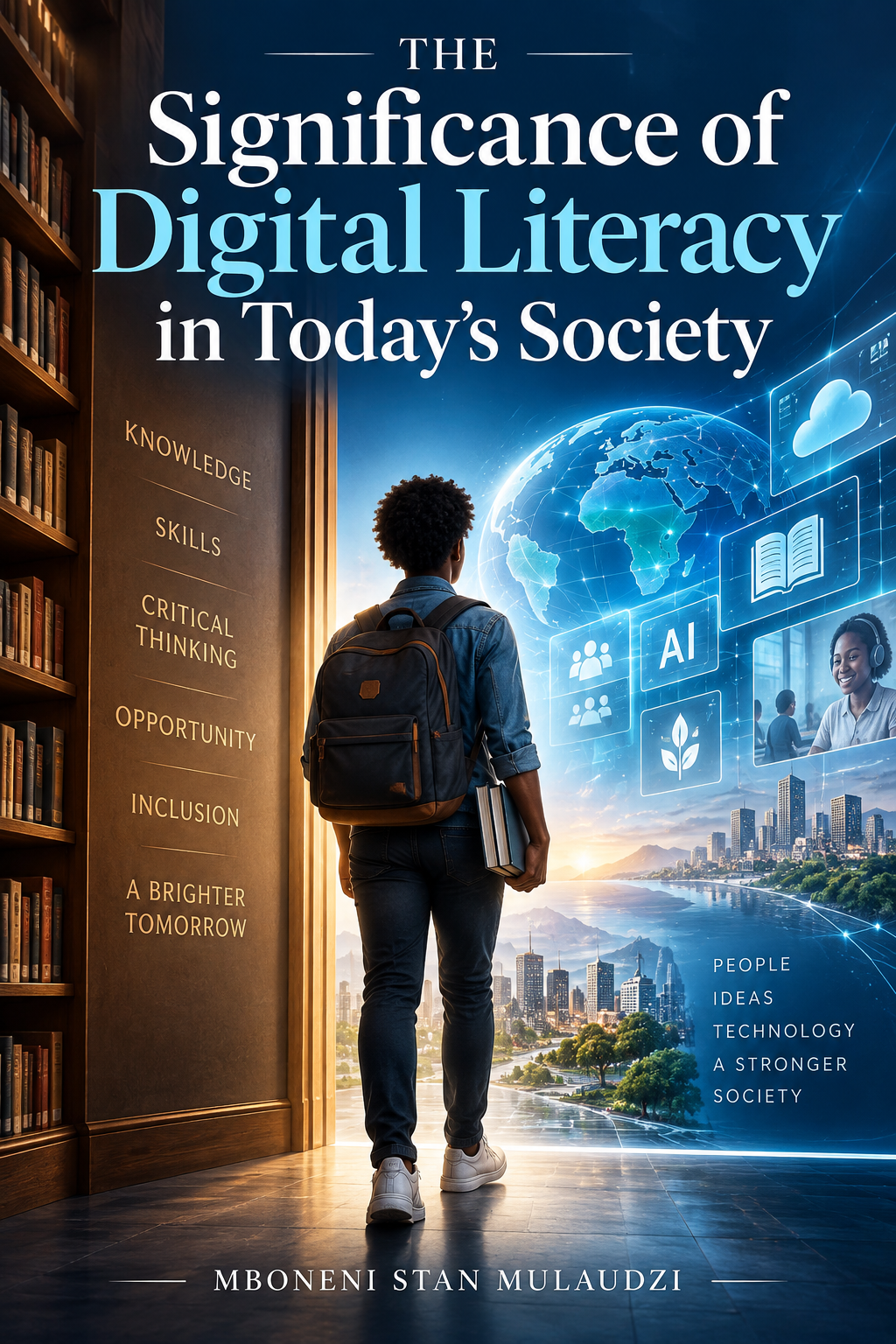
The Significance of Digital Literacy in Today’s Society
R149,00
Description
What if the most important skill of the twenty-first century is not knowing how to use technology—but knowing how to think with it?
We live in a world where a smartphone can become a classroom, a workplace, a marketplace, a newsroom, a bank, a library and a gateway to government services—all within the space of a few minutes. Yet access to technology does not automatically create understanding. In an age of artificial intelligence, misinformation, cyber threats, digital economies and rapidly changing workplaces, the ability to navigate the digital world intelligently has become one of the defining capabilities of modern life.
The Significance of Digital Literacy in Today’s Society is a compelling exploration of what it truly means to be digitally literate—and why it matters far beyond the ability to operate a computer or smartphone.
With clarity, depth and contemporary relevance, Mboneni Stan Mulaudzi takes the reader beyond basic technological competence into the deeper territory of critical thinking, information literacy, digital citizenship, cybersecurity, privacy, education, employment, entrepreneurship, social inclusion and artificial intelligence. The book asks a question that every educator, learner, professional, parent, entrepreneur and community leader must confront: Are we teaching people merely to use technology, or are we preparing them to live wisely in a digital society?
Digital literacy is presented not as an optional skill, but as a foundation for meaningful participation in contemporary life. The book examines how digital competence can transform education, expand employment opportunities, strengthen entrepreneurship, improve access to services and enable people to participate more confidently in society. At the same time, it confronts the uncomfortable realities of the digital age: misinformation, privacy risks, cybersecurity threats, unequal access, algorithmic influence and the growing gap between those who can access technology and those who can use it meaningfully.
The book is particularly powerful in its treatment of education. It challenges the assumption that placing technology in a classroom automatically produces better learning. Instead, it argues for purposeful technology use, digitally capable educators, critical learners and an educational culture that moves students from consumers of information to creators of knowledge.
Its exploration of artificial intelligence brings the discussion firmly into the present. As machines become increasingly capable of generating text, images, ideas and decisions, the human capacity for judgement becomes more—not less—important. The digitally literate individual must therefore learn not simply how to use AI, but how to question it, evaluate it, understand its limitations and remain accountable for its use.
At its heart, this is a book about human agency in a technological world.
It is about the learner who must navigate an ocean of information.
The worker who must continually adapt to changing technologies.
The entrepreneur who can turn digital capability into economic opportunity.
The citizen who must distinguish evidence from manipulation.
The educator who must prepare a generation for a future that is already arriving.
And the ordinary person who increasingly encounters essential parts of life through a screen.
The Significance of Digital Literacy in Today’s Society ultimately makes a profound proposition: the future will not belong simply to those who possess technology. It will belong to those who understand how to use it critically, creatively, ethically and purposefully.
Because digital literacy is no longer simply about knowing how technology works.
It is about knowing what to do with the world technology places at our fingertips.
And in that sense, digital literacy is not merely a skill for the future.
It is a literacy for living now.



Reviews
There are no reviews yet.